
Moon Phases
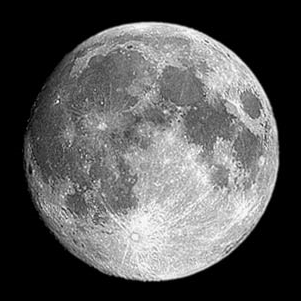
Tuesday, March 31, 2026
Waxing Gibbous 96% illuminated
Rise: 6:01 PM
Set: 5:47 AM
Eye on the Night Sky, August 20, 2026
Thursday, August 20, 2026
Today:
The Moon is just one day past its First Quarter tonight, as it nuzzles up close to the reddish star Antares, the “heart” of the Scorpion, low in the south-southwest as twilight gives way to darkness from 8:45 PM to 9 PM. The pair will slide lower into the southwest, with the Moon setting by 11:15 PM, and Antares about 15 minutes later.
Friday:
If you’re up and around during the predawn hours tomorrow, you’ll note a bright spark of light, low in the east-northeast near 5 o’clock, the giant planet Jupiter, making its return to the skies, though relegated to the early mornings until later this fall. Well above are the twin stars of Gemini, while the star Procyon shines well right of Jupiter. Above Procyon, and right of the Twins, Mars rests with the feet of Gemini.
Saturday:
Low in the failing southwestern twilight between 8:45 and 9:15 PM, you will find the bright, bluish-white star Spica nearing the end of its viewing for the year. Although Spica ranks just outside the top-ten brightest stars, at 250 light years away, actually outshines the Sun by 15 thousand times!
Start Chart:
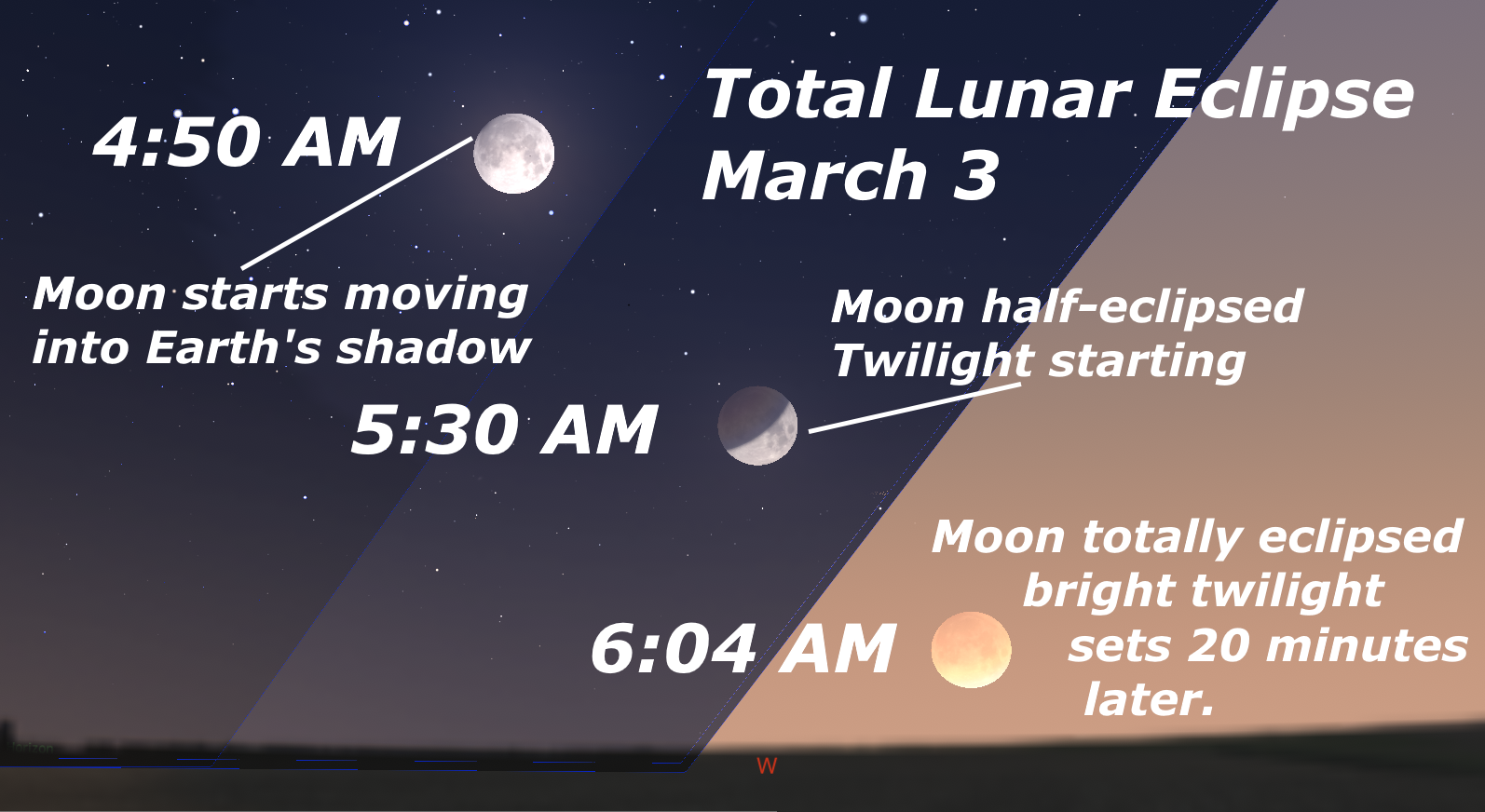
Total Lunar Eclipse
The Moon passes into the Earth’s shadow early Tuesday morning, March 3rd, 2026.
The Moon moves into the Earth’s shadow late at night on Tuesday, March 3rd, just as twilight increases. By the time the Moon is fully eclipsed, it becomes difficult to see in the brightening twilight, and it sets only 20 minutes after the eclipse is total.
The Earth’s rotation causes the stars, as well as the Moon, to rise in the east and set in the west. The Moon’s orbital motion, however, goes the opposite way, with the Moon actually moving from west to east, but much, much more slowly. This means the Moon’s expected motion, lowering toward the western horizon, comes from the Earth’s rotation. The Moon’s actual orbital motion causes it to move into the Earth’s shadow from lower right to upper left. This explains why the shadow starts on the Moon’s upper left, and progresses to the lower right.
Lunar eclipses aren’t rare, but they are also not frequent. The next Total Lunar Eclipse visible here is in June 2029, followed by another in December of 2029.

This program is a partnership between the Fairbanks Museum and Vermont Public.