

Moon Phases
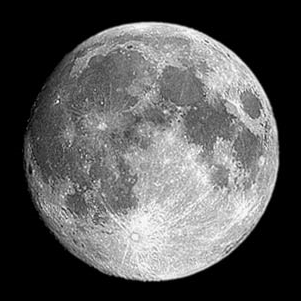
Tuesday, March 31, 2026
Waxing Gibbous 96% illuminated
Rise: 6:01 PM
Set: 5:47 AM
Eye on the Night Sky, June 3, 2026
Wednesday, June 03, 2026
Today:
Mercury makes its best evening showing of the year over the next ten days. Look low in the west-northwest this evening starting near 9:15 for a bright spark of light buried in the twilight, a bit more than the width of your hand, held at arm’s length, above a level horizon. Mercury will inch a little higher through the next week, but it begins to lose some of its brightness thereafter.
Start Chart:
Total Lunar Eclipse
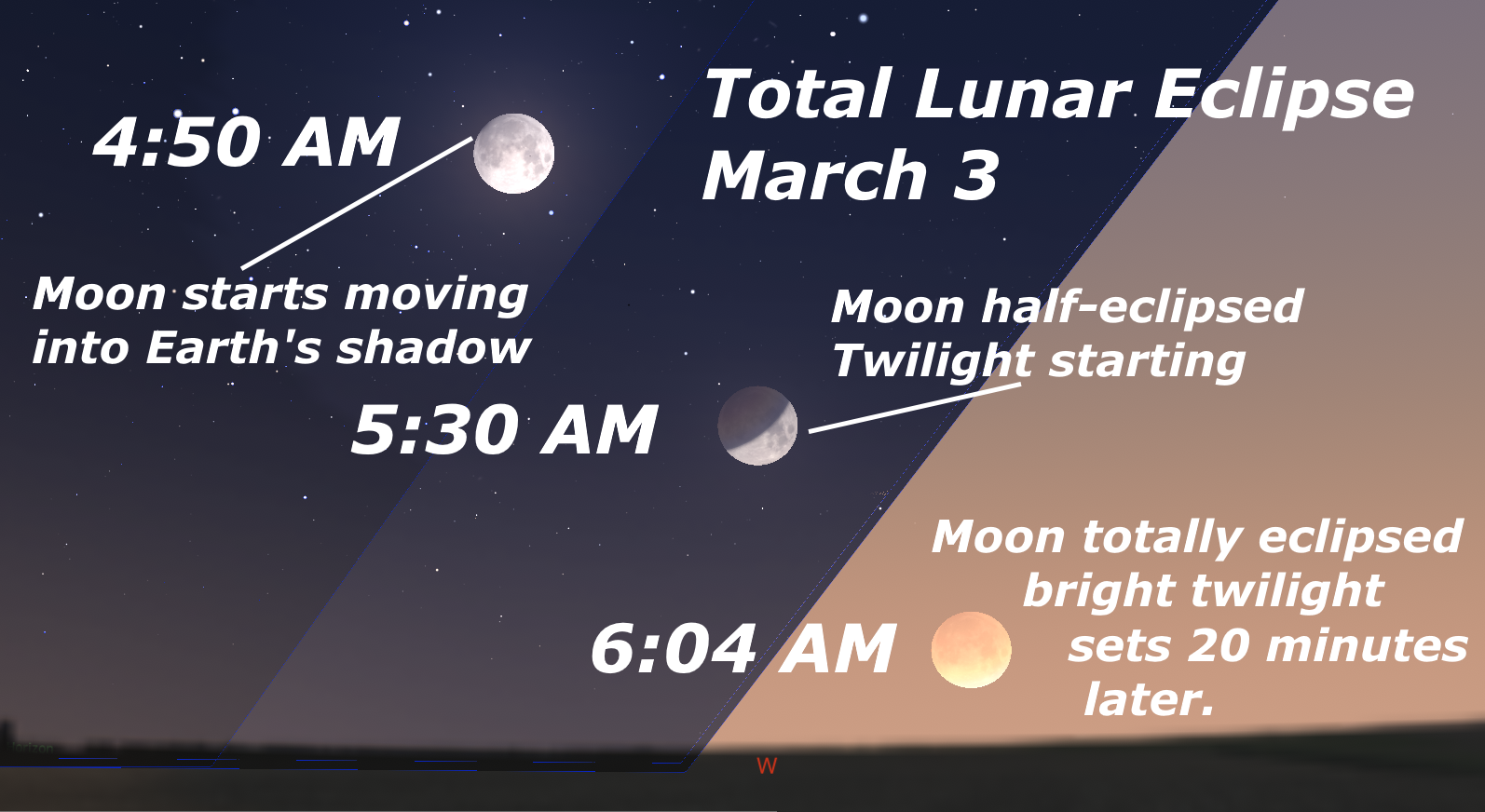
The Moon passes into the Earth’s shadow early Tuesday morning, March 3rd, 2026.
The Moon moves into the Earth’s shadow late at night on Tuesday, March 3rd, just as twilight increases. By the time the Moon is fully eclipsed, it becomes difficult to see in the brightening twilight, and it sets only 20 minutes after the eclipse is total.
The Earth’s rotation causes the stars, as well as the Moon, to rise in the east and set in the west. The Moon’s orbital motion, however, goes the opposite way, with the Moon actually moving from west to east, but much, much more slowly. This means the Moon’s expected motion, lowering toward the western horizon, comes from the Earth’s rotation. The Moon’s actual orbital motion causes it to move into the Earth’s shadow from lower right to upper left. This explains why the shadow starts on the Moon’s upper left, and progresses to the lower right.
Lunar eclipses aren’t rare, but they are also not frequent. The next Total Lunar Eclipse visible here is in June 2029, followed by another in December of 2029.

This program is a partnership between the Fairbanks Museum and Vermont Public.